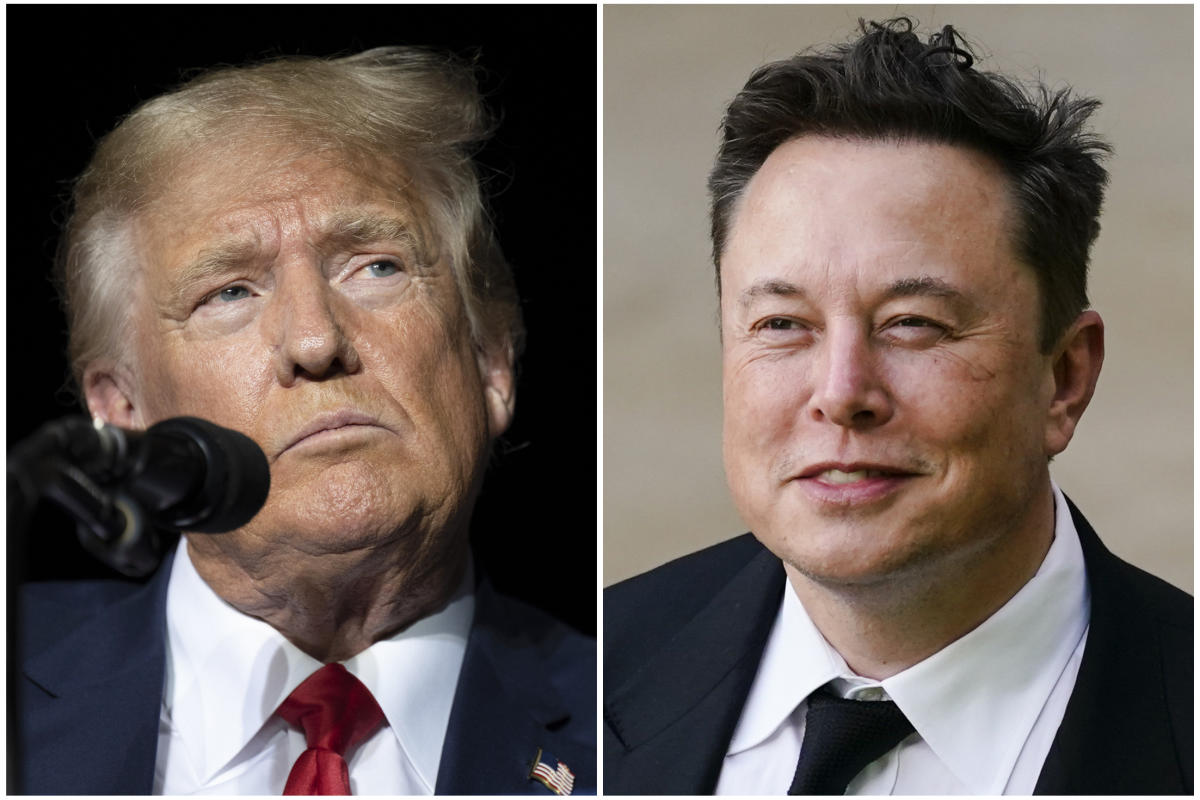
Donald Trump and Elon Musk talked for 2 hours in an interview. Find out what they discussed and why Trump agreed to it.
At 8 p.m. ET, hundreds of thousands of X users flocked to the platform to hear owner Elon Musk speak with Republican presidential candidate Donald Trump. But they would have to wait almost 45 minutes before the interview began because of what Musk called a denial of service attack.
Once the problems were resolved, Musk kicked off the discussion by emphasizing this was a “conversation” — one that ultimately stretched over two hours long, beginning with a question about Trump’s assassination attempt in July in Butler, Penn. Musk and Trump then worked their way through topics like immigration, foreign policy and the economy.
Trump’s X interview, his third social-media-first appearance in recent weeks, took place over X Spaces, a feature in the X app that lets users listen in and join live audio conversations with other users and groups. The interview is part of a strategy that journalist and conspiracy theory expert Mike Rothschild says is indicative of the types of voters the Trump campaign is courting. Rothschild also cited the changing election landscape in general, which is becoming increasingly less reliant on traditional media.
Interview delayed by technical issues
The conversation between Trump and Musk didn’t start until around 8:40 p.m. ET, with around 1 million listeners tuned in.
In a post, Musk blamed the delay on a distributed denial of service (DDoS) attack on the platform.
What did Trump and Musk say?
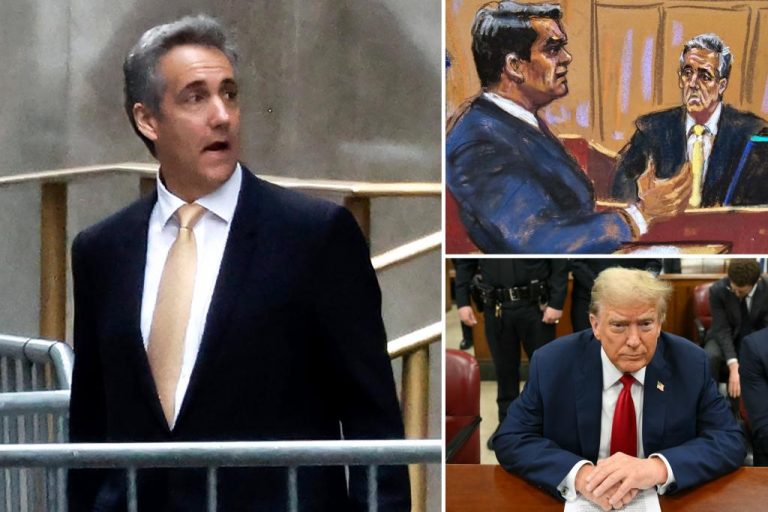
The conversation covered a number of key Trump themes: Recounting his assassination attempt in July, slamming his presidential opponent, Vice President Kamala Harris, for her role as “border czar,” and condemning President Biden over wars in Gaza and Ukraine.
The two also discussed immigration, with Trump repeating his frequent claim that murderers and other criminals were crossing into the U.S. Despite Trump’s statements, numerous studies have found that immigrants commit crimes at a lower rate than U.S.-born citizens. Trump added that “non-productive people” were also coming to the country.
Trump went after President Biden repeatedly, despite Biden having dropped out of the 2024 race weeks ago, a decision Trump referred to as “a coup.”
Musk also took the opportunity to bring up energy and at one point turned the conversation toward Tesla, his electric vehicle company. Trump, previously a critic of electric vehicles, called Tesla an “incredible” product in the conversation. At a rally on Aug. 3, Trump said he had to like electric vehicles because “Elon endorsed me very strongly.”
The Harris campaign sent out an email a little after 9 p.m. ET calling the conversation “a big deal” because “the richest person in the world is a lackey for Team MAGA.”
How does this fit into the Trump campaign’s larger communication strategy?
This marks the third social-media-first interview Trump has done in recent weeks. In June, he gave an interview to YouTuber-turned-wrestler-turned-energy-drink-entrepreneur Logan Paul.
More recently, Trump joined a stream on the platform Kick with controversial 23-year-old streamer Adin Ross on Aug. 5. At its peak, the video had over 580,000 concurrent viewers. Ross has made headlines in the past for being banned from the popular streaming platform Twitch for using homophobic slurs, sharing racist and antisemitic messages in his live chat and displaying pornographic images during streams to his predominantly teenage audience.
Trump’s vice presidential pick, JD Vance, also made an appearance on a podcast hosted by the YouTube group Nelk Boys on Aug. 1, which he leveraged to help launch his TikTok account. The Nelk Boys are no strangers to controversy and regularly promote ring-wing political causes and incel culture.
The target audience can be described as “hyper-masculine edgelords,” referring to people who try to have the most provocative and contrarian opinions, especially online. This group is not plugged into traditional news sources, Rothschild argues, and they most likely think that “voting is a joke and for losers.”
“He’s really trying to reach these people because this is kind of the only potentially new demographic he has left,” Rothschild argued. “His base is not growing.”
The Associated Press reported in February that there were some doubts over whether Trump could expand his base, made up of mostly white, middle-aged men, and win over new Republicans or undecided voters.
Trump’s return to X and interview with Musk is all about amping up his dedicated base and enticing them enough to get them to the polls in November, especially as Harris has seen an explosive surge in the polls recently. The interview is not about clearing up Trump’s past controversial comments or providing insight into what a potential second Trump administration would look like.
“This is not going to be any kind of an attempt to find consistency in the things that [Trump] has said, because the people who are watching this don’t care,” Rothschild said. “It’s the spectacle. We’re bypassing legacy media and we’re going straight to the people.”
What does Elon Musk get out of this?
Despite how publicly Musk has embraced Trump — even to the detriment of Tesla’s sales — the former president has stayed off of X for almost a full year. But Trump’s return could help boost the platform, which has been struggling against lawsuits, declining user growth and its own advertisers.
Musk, who has endorsed Trump for president, has also been accused of censoring liberal political content on X, as well as promoting inaccurate information, both which promote the Trump campaign to the platform’s 540 million users. In an Aug. 12 letter to the House Judiciary Committee, Rep. Jerrold Nadler demanded an investigation into X, calling some of the content “deceptive or harmful” to “democratic elections at large.”
Others have speculated that Musk is trying to redeem himself and X after Ron DeSantis’s disastrous and glitchy presidential bid launch in May 2023. Even Trump made fun of the stream at the time.