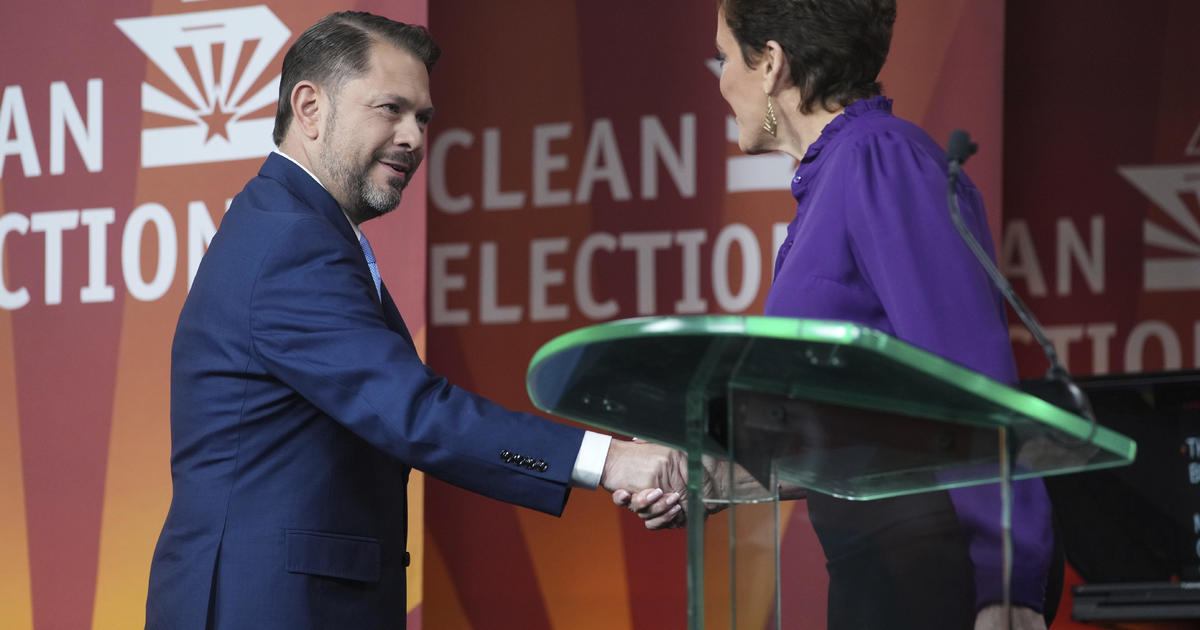
Kari Lake and Ruben Gallego argue about immigration and trade insults during debate
Republican Senate candidate Kari Lake is leveraging her three-decade career in Arizona television to connect with voters and refute claims made by Democrat Ruben Gallego in their closely-watched race. The outcome of this Arizona race is crucial in determining the balance of power in the U.S. Senate, where Democrats are striving to maintain their narrow majority. The victor will succeed independent Sen. Kyrsten Sinema, who defected from the Democratic Party in 2018.
Both candidates are vying for the support of a segment of Republicans and conservative independents who are open to splitting their votes between parties. This demographic has played a pivotal role in the Democratic Party’s surge in Arizona, transforming the state from a Republican stronghold to a battleground.
Lake’s ease and professionalism in front of the camera contrasted with Gallego’s occasional stumbling over words during the recent debate. The dynamic and sometimes personal exchanges during the hour-long debate highlighted stark disagreements on topics such as immigration, border security, abortion, and taxes.
Opening the debate, Lake greeted viewers with a familiar tone and emphasized her long-standing relationship with the audience, harkening back to her roots in local television news.
In a bid to paint Gallego as a progressive in disguise, Lake accused him of undergoing an “extreme makeover” to obscure his track record in the U.S. House, aligning him with chaos on the U.S.-Mexico border.
Gallego, on the other hand, labeled Lake as untruthful, referencing her debunked assertion of winning the 2022 gubernatorial race.
Lake, once a prominent figure on the right-wing political spectrum post her departure from TV news, has struggled to redefine herself since her electoral setback in 2022.
Meanwhile, Gallego, who represents predominantly Latino areas in Phoenix, has capitalized on his financial advantage over Lake, highlighting his military service and rags-to-riches narrative rather than his progressive credentials in Congress.
The televised debate offered Lake an opportunity to reset a race where polls and experts indicate she is trailing slightly. For Gallego, it was a chance to introduce himself to voters who remain unfamiliar with him.
The initial segment of the debate revolved around immigration and border security, which Lake has made central to her campaign messaging. She criticized Gallego for his previous statements rejecting a border wall, linking him to President Biden’s border policies, and accusing him of backing “open borders” and voting against border security measures.
Gallego defended the necessity of borders and walls in bolstering security but underscored that they must be complemented with adequate manpower and technology. He faulted Lake for opposing a bipartisan border security proposal endorsed by Biden and key lawmakers, which faltered after ex-President Trump urged Republicans to reject it.
The debate stretched to immigration issues, with Lake pushing for the deportation of all undocumented immigrants and Gallego advocating against deporting “dreamers”, a group brought into the U.S. as children.
Both candidates sought to steer the discourse toward topics advantageous to their campaigns – immigration for Lake and abortion rights for Gallego. A recent state Supreme Court ruling led to the near prohibition of abortions until the legislature revised the ban to allow terminations after 15 weeks of pregnancy. Lake has expressed support for stricter limitations on abortions.
Gallego underscored Lake’s admiration for the repeal of Roe v. Wade and questioned whether politicians like her should play a role in such personal decisions which should ideally rest with women and their families.
Lake clarified that she wouldn’t endorse a federal ban on abortions and referenced an upcoming ballot initiative in Arizona that will address the state’s abortion laws.
Notably, Lake is an ardent supporter of Trump and his unsubstantiated claims of electoral fraud in the 2020 election. She has yet to concede her own defeat in the 2022 gubernatorial race, pursuing legal avenues even after launching her Senate campaign. Her efforts to outlaw electronic voting machines were unsuccessful, including a plea rejected by the U.S. Supreme Court earlier this year.
She also raised Gallego’s 2016 divorce from Kate Gallego, now the mayor of Phoenix, insinuating that he abandoned his pregnant wife. Kate Gallego, however, has endorsed her former spouse and appeared alongside him in recent campaign efforts.
Gallego, the son of immigrants from Mexico and Colombia, was raised by a single mother in Chicago before gaining admission to Harvard University. He enlisted in the U.S. Marine Corps Reserve during a hiatus from Harvard and served in Iraq in 2005, witnessing profound losses, including the death of his best friend.
Throughout the debate, Gallego underscored his military service as a testament to his character and qualifications for public office.
The battle between Lake and Gallego encapsulates the fervent struggle for power in the Arizona Senate race, a contest that could influence the broader political landscape. With each candidate emphasizing distinct policy stances and personal narratives, voters are tasked with deciding the future trajectory of the state and the critical issues at stake.