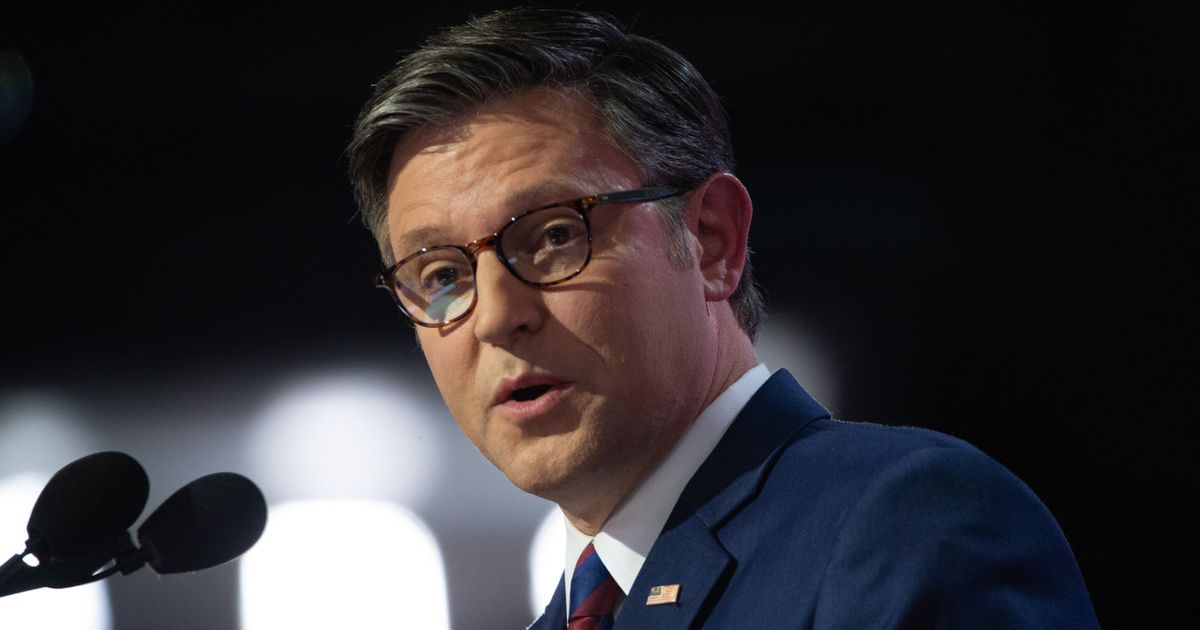
Mike Johnson says Democrats cannot replace Biden.
House Speaker Mike Johnson made headlines on Sunday when he declared that replacing President Joe Biden as the presumptive Democratic nominee would be considered “unlawful.” This statement came just hours before President Biden officially announced his decision to step aside from the race.
In an interview on ABC’s “This Week,” the Louisiana Republican voiced his concerns about potential legal challenges that some states could face if they attempted to replace Biden with another Democratic candidate on the ballot. Johnson emphasized that it would be against the rules of certain states to switch out a candidate because of personal preferences.
Shortly after Johnson’s remarks, President Biden released a letter formally announcing his withdrawal from the race and endorsing Vice President Kamala Harris as his successor. Despite dropping out of the race, Biden expressed his intention to complete his term as president. Following this announcement, Speaker Johnson called for Biden’s resignation without delay.
However, the question arises: Is Johnson correct in suggesting that legal issues would arise if a new candidate were to be nominated? Election law expert Rick Hasen of UCLA dismissed these concerns earlier this month, stating that Democrats should be able to legally nominate a different individual without any obstacles.
While Johnson did not provide specific legal arguments to support his claims, some speculate that his remarks alluded to Ohio’s previous law, which mandated parties to finalize their official nominees 90 days before the election. However, Ohio has since amended this law, effective Sept. 1, allowing Democrats to submit their nominee post-DNC.
It is anticipated that Republicans and affiliated groups, such as the Heritage Foundation, may still initiate legal challenges against the Democratic Party’s nominee in various states. The Heritage Foundation, known for its Project 2025 blueprint aimed at reducing federal government influence, highlighted the potential for pre-election litigation that could complicate Biden’s replacement on the ballot.
Speaking vaguely on Sunday, Johnson did not explicitly hint at his party’s involvement in potential lawsuits. However, in a subsequent statement, he blamed Democrats for allegedly coercing President Biden to exit the race.
Amidst these legal uncertainties, Johnson’s statements coincided with the recent Republican National Convention where he and the GOP formally nominated former President Donald Trump. Notably, Trump faced controversy for promoting baseless claims of voter fraud and instigating his supporters to storm the Capitol in a bid to overturn the 2020 election results.
As the political landscape continues to evolve, the issue of Biden’s replacement raises crucial legal and ethical questions. With conflicting perspectives from various experts and politicians, the decision regarding the Democratic Party’s nominee remains uncertain. The upcoming months leading to the November election will undoubtedly witness intense debates and legal battles that could shape the outcome of the presidential race.