Service industry workers share thoughts on Trump working at McDonald’s
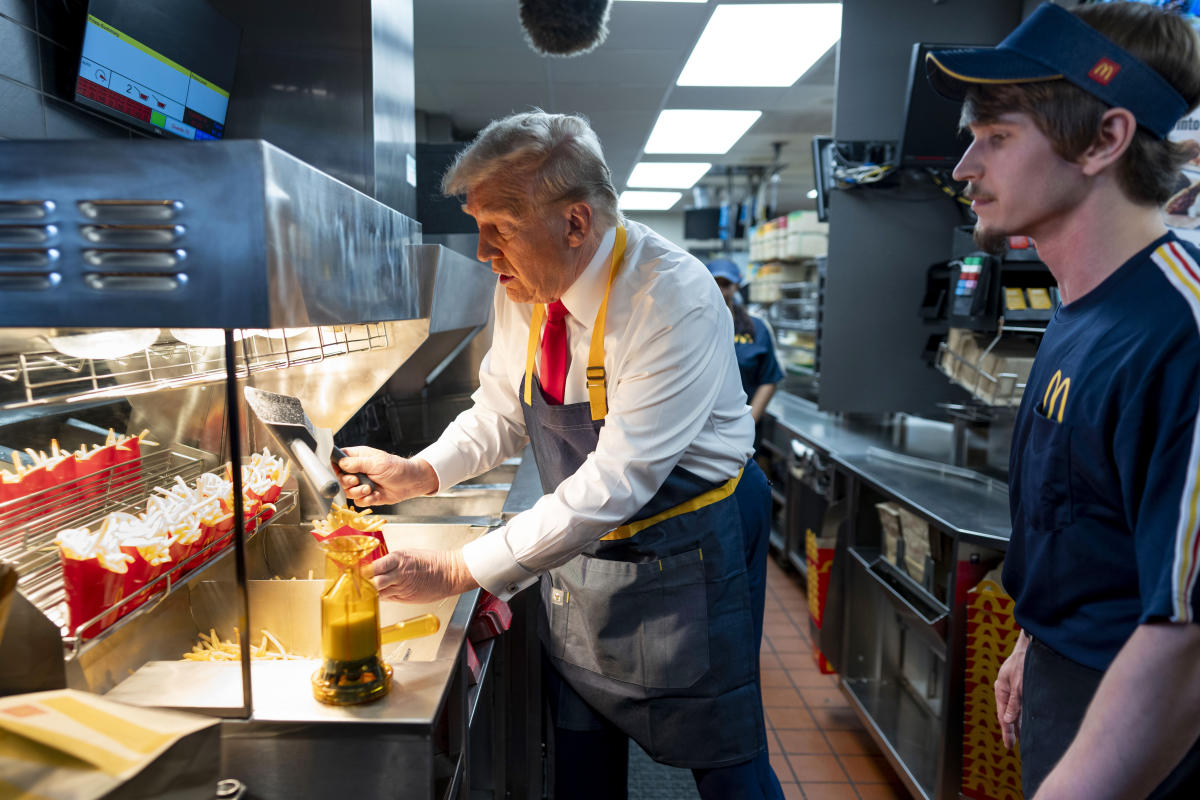
Donald Trump recently made headlines when he decided to man the fry station at a McDonald’s in Pennsylvania during a weekend campaign stop. This move was seen as a response to Vice President Kamala Harris, who has claimed to have worked at the fast-food chain in 1983. Trump has been vocal about accusing Harris of lying about her time at McDonald’s, suggesting that she is trying to portray herself as having working-class roots.
McDonald’s released a statement saying that they do not have employment records for all positions dating back to the early 80s, indicating that there is no concrete evidence to support Trump’s claims that Harris did not work there. However, Trump’s appearance at McDonald’s, where he spent five minutes scooping fries and 15 minutes answering reporters’ questions at the drive-through window, led to him jokingly remarking, “I’ve worked for 15 minutes more than Kamala.”
It’s important to note that the McDonald’s was closed to the public during Trump’s visit, with only Trump supporters prescreened by the U.S. Secret Service present. No food was ordered, and customers received whatever Trump chose to give them. McDonald’s further clarified in a statement that they do not endorse any political candidate.
According to McDonald’s, one in eight Americans have worked at the chain at some point in their life, highlighting the influence and reach of the fast-food giant in American society.
While Trump’s stint at McDonald’s garnered attention, many have criticized it as a political stunt aimed at showcasing a connection to everyday struggles without real substance behind it. Some have viewed it as a move by Trump to project a false image of having blue-collar roots, despite lacking evidence to refute Harris’s claims of working at the fast food chain. Others have pointed out that Trump avoided addressing important issues during his visit, such as his stance on the minimum wage.
Comedian Roy Wood Jr., a vocal critic of Trump’s McDonald’s appearance, emphasized the importance of truly understanding and respecting blue-collar and service industry jobs. He highlighted the challenges and skills required in such roles, questioning the authenticity of politicians participating in basic tasks for photo ops.
Trump is not the first presidential candidate to engage in such activities. In the past, politicians like George H. W. Bush, Bill Clinton, Al Gore, and John McCain have also been photographed performing everyday job tasks to connect with voters. This trend of politicians cosplaying as regular Americans seems to be a common strategy in political campaigns to engage with a broader audience.
Wood believes that this trend is likely to continue as politicians seek new ways to reach voters in an increasingly digital and fragmented media landscape. He stressed the importance of truly understanding and valuing the experiences of individuals working in service industries and blue-collar jobs, rather than simply using them as props for political gain.
Overall, Trump’s McDonald’s visit generated mixed reactions, with some seeing it as a transparent political move while others viewed it as a genuine attempt to connect with working-class Americans. Regardless of opinions, it is evident that the intersection of politics and everyday life continues to be a complex and evolving phenomenon in the realm of American politics.