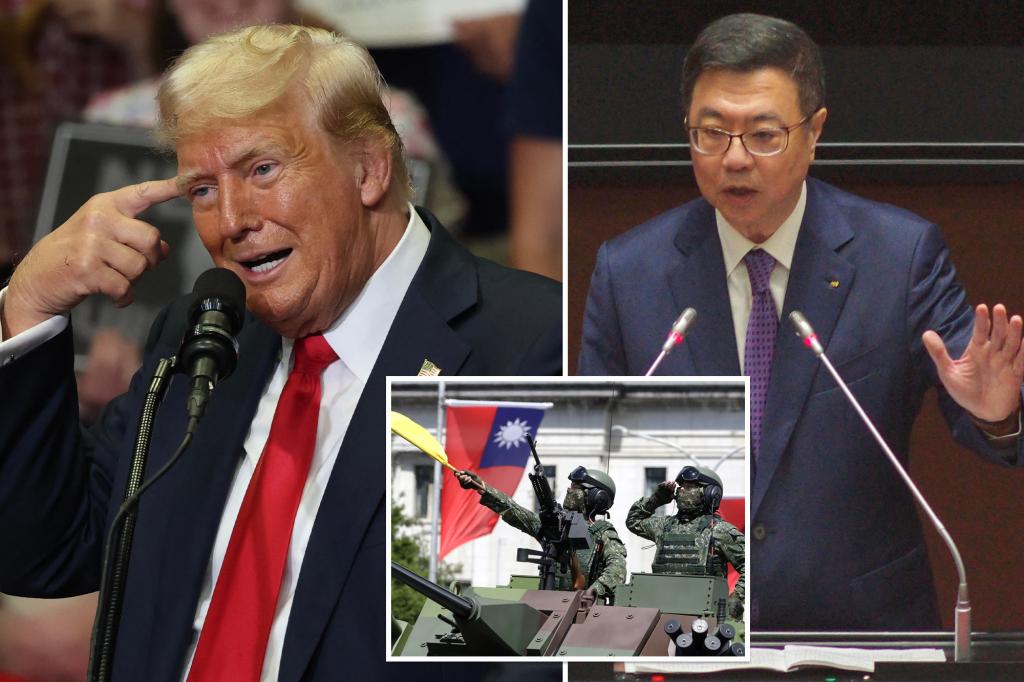
Taiwan responds to Trump’s comments about defense payment.
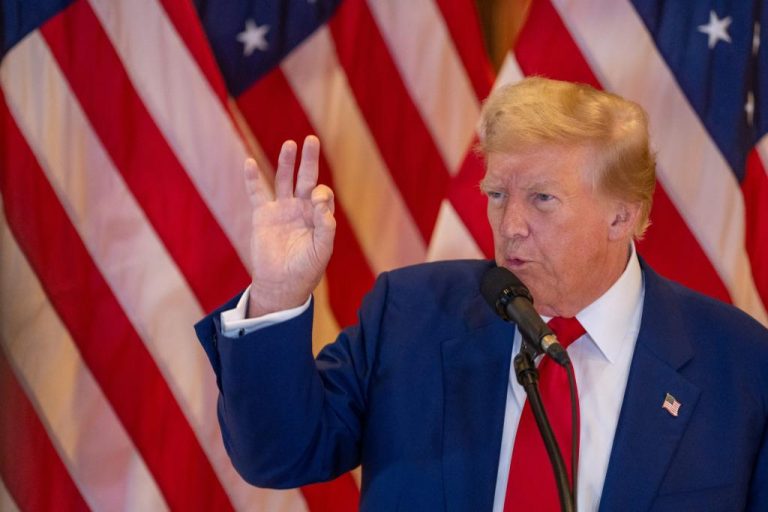
President Trump’s recent remarks suggesting that Taiwan should pay the United States for defense have stirred up strong reactions from officials and citizens in Taiwan. The comments, made during an interview with Fox News, have sparked a debate over the relationship between the two nations and the broader implications for regional security.
While Taiwan has long relied on the United States for military support and protection, Trump’s suggestion that they should contribute financially has raised concerns about the future of their alliance. Taiwanese officials have expressed surprise and disappointment at the remarks, emphasizing the importance of their partnership with the U.S. in maintaining stability in the region.
Many in Taiwan view the U.S. as a crucial ally in deterring potential aggression from mainland China, which considers Taiwan to be a part of its territory. The security umbrella provided by the U.S. military is seen as essential for countering any threats or provocations from Beijing.
Trump’s comments have also reignited debates within Taiwan about the country’s defense spending and military capabilities. Some have argued that Taiwan should indeed increase its defense budget to better align with its security needs, while others have raised concerns about the financial burden this would place on the government and its citizens.
The debate over defense spending in Taiwan is not new, but Trump’s remarks have brought renewed attention to the issue. The question of how much Taiwan should contribute to its own defense, and how much it should rely on the U.S. for support, is a complex and multifaceted issue that is being hotly debated across the country.
Many Taiwanese citizens have taken to social media to express their opinions on Trump’s comments, with some criticizing the president for his lack of understanding of the historical and geopolitical context of the Taiwan-U.S. relationship. Others have defended Trump’s position, arguing that it is reasonable to expect Taiwan to shoulder some of the financial burden for its own defense.
At the heart of this debate is the question of how to best ensure Taiwan’s security and sovereignty in the face of growing challenges from China. As tensions in the region continue to escalate, finding a balance between self-reliance and partnership with the U.S. will be crucial for Taiwan’s future security and stability.
In the coming weeks and months, it is likely that the debate over defense spending and the Taiwan-U.S. alliance will continue to dominate headlines in both countries. The outcome of these discussions will have far-reaching implications for the security and stability of the Asia-Pacific region as a whole.
As Taiwan grapples with the fallout from Trump’s controversial comments, one thing is clear: the relationship between Taiwan and the United States is at a critical juncture, and the decisions made in the coming months will shape the future of their partnership for years to come.