Trump wants migrants to love America in order to enter, if he wins.
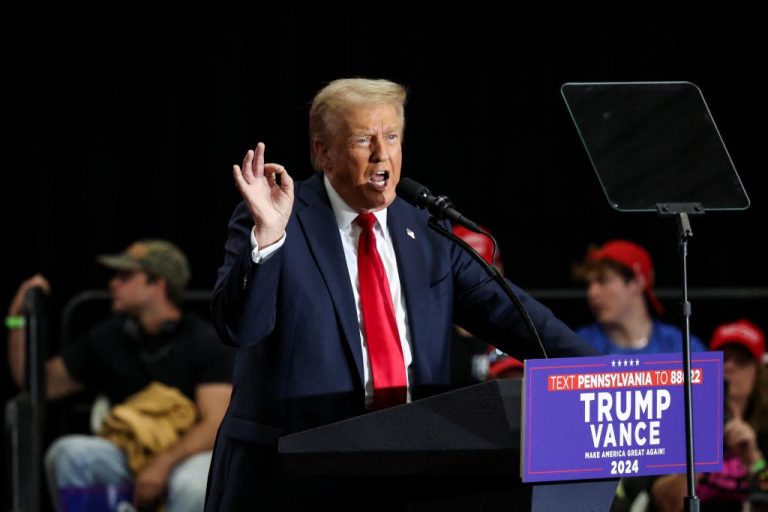
During a recent Univision forum, former President Donald Trump made a bold statement regarding immigration policy if he were to be re-elected. Trump declared that migrants seeking entry into the United States would have to “love our country” in order to be allowed in.
Trump’s remarks come amidst a heated debate surrounding immigration reform and border security in the United States. His stance on the issue has been a focal point of his political career, with many praising his tough stance on illegal immigration while others criticize his approach as harsh and unwelcoming.
If Trump were to win another term in office, his stated policy would mark a significant shift in the country’s approach to immigration. The concept of requiring migrants to demonstrate their love for the United States as a condition of entry raises questions about what such a requirement would entail and how it would be enforced.
Proponents of Trump’s stance argue that love for one’s country is a fundamental value that should be expected of all those seeking to become citizens. They believe that this requirement would help ensure that those coming to the United States are committed to contributing positively to society and upholding American values.
However, critics of Trump’s proposal argue that such a requirement is impractical and discriminatory. They point out that love for a country is a difficult sentiment to measure and that using it as a basis for entry could result in arbitrary decision-making and unfair treatment of certain groups.
Furthermore, opponents of Trump’s policy argue that it goes against the core principles of the United States as a nation that has historically welcomed immigrants from diverse backgrounds. They argue that imposing a love for the country as a condition of entry would contradict the values of freedom and opportunity that the United States has long sought to uphold.
Trump’s statement has sparked a wide range of reactions from both supporters and critics. Some view it as a necessary step to ensure national security and preserve American identity, while others see it as a dangerous precedent that could lead to increased discrimination and hostility towards immigrants.
As the debate over immigration policy continues to unfold, it is clear that Trump’s proposal has added a new dimension to the discussion. Whether or not his stance on requiring migrants to “love our country” will gain traction remains to be seen, but it has certainly reignited discussions about the values that should guide immigration policy in the United States.
Ultimately, the issue of immigration and border security is one that will continue to be a divisive and contentious topic in American politics. Trump’s proposal is just one example of the many different perspectives and approaches that exist on this complex and multifaceted issue.
As the country grapples with the challenges and opportunities presented by immigration, it is clear that finding a balance between security and compassion, openness and control, will be key to shaping the future of immigration policy in the United States.